

SHARE:
Plan your team-building programme
Share your objective, headcount, dates and location to discuss a customised programme.
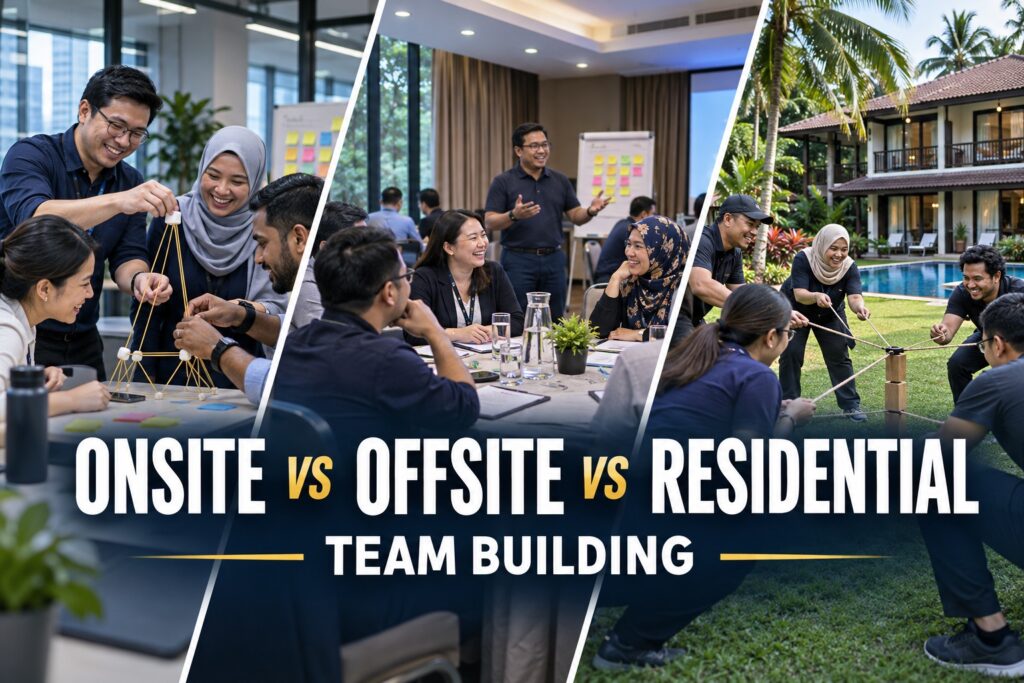
Onsite team building takes place at your workplace, offsite team building takes place away from it, and residential team building includes an overnight stay. Choose onsite if your workplace has suitable space and staff can protect the time. Choose a non-residential offsite if the group needs an external venue, or consider a residential programme if an overnight stay justifies the extra travel, accommodation and time away.
Choose the setting around your team’s objective, who can attend and what your organisation can support. Plan activities, discussion and follow-through for that objective. Image Revamp’s corporate team-building programmes in Malaysia provide a starting point for discussing your team’s objective and practical requirements.
What is the difference between onsite, offsite and residential team building?
The difference is where participants meet and whether they stay overnight. Residential programmes are generally offsite too. The table separates them because an overnight stay adds decisions about accommodation and participation.
| Decision factor | Onsite at the workplace | Offsite without an overnight stay | Residential with an overnight stay |
|---|---|---|---|
| Space and focus | Familiar space; work interruptions need active management. | An external venue can help protect programme time if managers agree on availability. | Time away can create more opportunities for conversation; the agenda and participants’ availability determine how that time is used. |
| Operational disruption | Less event travel for staff already at the site, but colleagues may be pulled back to work. | Travel and time away need cover; the team is less immediately available at the workplace. | Overnight absence and travel need more planning for cover, personal commitments and handover. |
| Logistics | Check room capacity, privacy, equipment, catering and site access. | Add venue suitability, travel, arrival times and backup arrangements. | Add room allocation, overnight access, meals and arrival and departure arrangements. |
| Budget factors | Existing space may reduce venue or travel costs; setup, cover and equipment can still cost money. | Venue, travel and meals may add costs; compare the whole quote with onsite costs. | Accommodation and additional meals may add costs; compare travel and cover alongside the rest of the scope. |
| Group fit | Useful when staff need to remain close to operations and a suitable space exists. | Useful when a neutral space or different activity environment matters and the group can travel. | Useful when an overnight stay supports the objective and participants can take part equitably. |
A workplace session can run over more than one day, and an offsite session does not need an overnight stay. Decide setting and duration separately. Allow time for activities, breaks, discussion and travel in whichever setting you choose.
When is onsite team building a good fit?
Onsite team building is a good fit when the workplace has suitable space, participants can protect their time and the team needs to stay close to operations.
For example, a department with an accessible training room and a specific handover problem could use a guided exercise and discussion at its own office. Staff may avoid a separate journey, and familiar work examples are close at hand. The organiser still needs to plan cover and make it clear when participants are unavailable for routine work.
Check these conditions before choosing the workplace:
- Space: Can everyone hear, move, work in smaller groups and participate safely? Is the room private enough for the discussion?
- Interruptions: Can managers agree cover, silence notifications and keep routine calls outside the session?
- Equipment and access: Are the layout, AV, toilets and routes suitable for the planned activities and participants?
- Practical support: Who arranges room setup, refreshments, visitors, security access and any alternative space?
Onsite is less suitable when the available room restricts the activity or participants will repeatedly be called away. Include staff cover and any equipment or setup needed when comparing the cost of using office space.
When is a non-residential offsite a good fit?
A non-residential offsite is a good fit when the team needs a separate space or facilities that the workplace cannot provide, but an overnight stay is unnecessary or impractical.
A cross-functional group based in different offices, for example, could meet at a venue accessible from each location. The organiser can protect the session from routine interruptions by agreeing staff availability with managers and allowing enough time for discussion. A hotel meeting room, training centre or other external space may suit the group’s activity and access needs.
Compare actual door-to-door journeys, not only the venue address. A location convenient for headquarters may be difficult for shift workers or colleagues travelling from another state. Confirm usable space, travel arrangements, meals, prayer and access requirements, and an indoor alternative if outdoor activities depend on weather.
When is residential team building a good fit?
Residential team building is a good fit when an overnight stay supports the programme or makes travel practical, and the group can reasonably participate.
An overnight stay may give colleagues travelling from different locations a practical way to meet without making a long return journey on the same day. It may also provide additional shared time around structured sessions. Explain what that time is for and allow for rest; staying together does not automatically create trust, deeper learning or better workplace results.
Before proposing a residential setting, ask four questions:
- What does the overnight stay enable? Name the discussion, activity or travel need that would be difficult to accommodate otherwise.
- Can participants attend? Ask early about caring responsibilities, shift cover, travel, religious observance and accessibility, using a private route for individual needs.
- What needs to be arranged? Confirm room and bathroom accessibility, room allocation, meals, transport, emergency contacts and who owns each decision.
- What is the alternative? Consider whether a non-residential option or agreed participation arrangement would meet the objective for people unable to stay overnight. Check that anyone using an alternative can take part meaningfully.
Treat evening social time as a separate choice from essential programme work. Explain the expected schedule in advance and discuss attendance arrangements with participants and the employer.
How do the settings compare for disruption and immersion?
Onsite generally keeps participants closest to their normal work, while an offsite or residential programme places more physical distance between the team and its routine; actual disruption depends on cover, travel and the ground rules.
For onsite delivery, reserve the room and agree who handles urgent issues so participants do not spend the session returning calls. For an external venue, decide who covers operations and what counts as an interruption worth escalating. For a residential programme, include the overnight absence in the cover plan and check the effect of travel on the next working day.
Immersion depends on protected attention and purposeful participation. An offsite with constant calls can be less focused than a well-protected onsite session. Equally, a residential programme with too little rest or unclear participation expectations may make it harder for people to engage.
How do setting, activities and follow-through affect learning depth?
Learning depth depends on the objective, activity design, reflection and workplace follow-through across all three settings.
Ask the proposed provider what participants will practise, how the facilitator will help them discuss the experience and what the team will take back to work. For a handover objective, that could mean practising how to agree the next owner and information needed, then choosing a handover question to trial at work. A manager could review its use later; any business improvement would need separate evidence.
A residential setting can make more shared time available, but a longer or more distant event is not proof of deeper learning. If repeated practice and manager reinforcement are needed, compare team building and team development before treating a single event as the whole solution.
Which setting costs less for corporate team building?
The least expensive setting depends on the complete scope, participant locations and operational cover, so compare itemised quotations rather than assuming onsite is always cheapest.
| Cost or commitment | Questions to compare |
|---|---|
| Programme | Are programme design, facilitator fees, materials, equipment and any agreed outputs included? |
| Space and setup | Are room hire, AV, furniture setup, access needs and an alternative space included? What would the workplace need to provide? |
| Travel and meals | Who pays for participant travel, parking, transfers, refreshments and meals? |
| Overnight stay | If residential, what rooms, meals and accommodation arrangements are included? |
| Operations and changes | What staff cover, cancellation terms, additional charges, applicable taxes and contingency provision apply? |
Ask each supplier to state inclusions, exclusions, payment and cancellation terms, and the headcount or dates on which the quote depends. Consider both the amount paid to suppliers and internal costs your organisation tracks, such as cover or time away from operations. A lower venue quote may not mean a lower total once travel and other requirements are included.
If HRD Corp funding is relevant, check the specific employer, provider and course requirements, approval and each proposed cost. An overnight package or social activity is not automatically covered. Read how HRD Corp team-building grants and claims work and check HRD Corp’s current Claimable Courses guidance before relying on funding.
How do you choose a setting for your group?
Choose the setting that meets the team’s main objective and fits participants, operations and the approved budget. Compare each option in five steps:
- Define the outcome. What should the group discuss, practise or agree? Identify the most important objective.
- Identify non-negotiables. Record participant locations, shift cover, travel limits, access needs, available spaces and any overnight constraints.
- Shortlist feasible settings. Rule out an option only after checking whether its constraints can be addressed; ask the group about participation needs privately.
- Compare like-for-like scope. Ask for the same programme objective, headcount and support in each estimate, with venue, travel, meals, accommodation and cover shown where relevant.
- Protect the learning and agree ownership. Confirm usable programme time, debrief, follow-through, decision owners and contingency arrangements before booking.
For example, a Klang Valley operations team with limited cover may prefer a protected onsite session if its space is suitable. A group arriving from several states may instead compare a non-residential venue with an overnight stay after checking travel, participation and total costs. The same group may make a different choice when its objective or constraints change.
Ask participants privately about access and support needs early. Check the full route and the activities, not only the venue entrance; the Australian Human Rights Commission’s accessible events guide covers venue, transport and participation considerations. It is a practical planning reference, not Malaysian legal guidance.
Frequently asked questions
The answers below cover common questions about travel, participation and venue changes.
Is a hotel meeting room always a residential programme?
No. A hotel can host a non-residential offsite when participants leave without staying overnight. It becomes residential for the purposes of this comparison when the programme includes an overnight stay.
Can onsite team building work for employees from several offices?
Yes. One office can host colleagues from other locations if the space, accessibility, travel and cover arrangements work for the whole group. Compare the journeys for all participants before treating the host office as the convenient option.
Does an offsite need outdoor or physical activities?
No. An offsite describes the location, not the activity. A group can use an external meeting room for guided discussion or exercises. Choose activities and alternatives that fit the objective and participants’ needs.
What if some employees cannot stay overnight?
Discuss their constraints privately and consider a non-residential setting or an agreed alternative that lets them participate meaningfully. Confirm any travel, schedule and budget implications before presenting the arrangement as final.
Can a team-building setting change after a venue is booked?
Possibly, but check the venue and supplier contracts, availability, participant arrangements and internal approvals before changing it. If an HRD Corp grant is involved, check the current rules and approval implications before making a change.
Do we need to decide the setting before contacting a provider?
No. Share the objective, estimated group size, locations, preferred dates and constraints, and explain which setting decisions remain open. Ask for the assumptions, responsibilities and itemised scope behind any recommendation.
Discuss the right setting for your team
Start the conversation with your objective, estimated headcount, location and main constraint, such as shift cover, travel or overnight availability. Mention whether you are comparing onsite, offsite and residential options or need a recommendation.