

SHARE:
Choose the Right Team Intervention
Share the team situation, desired behaviour and follow-through expectations so we can recommend the right level of intervention.
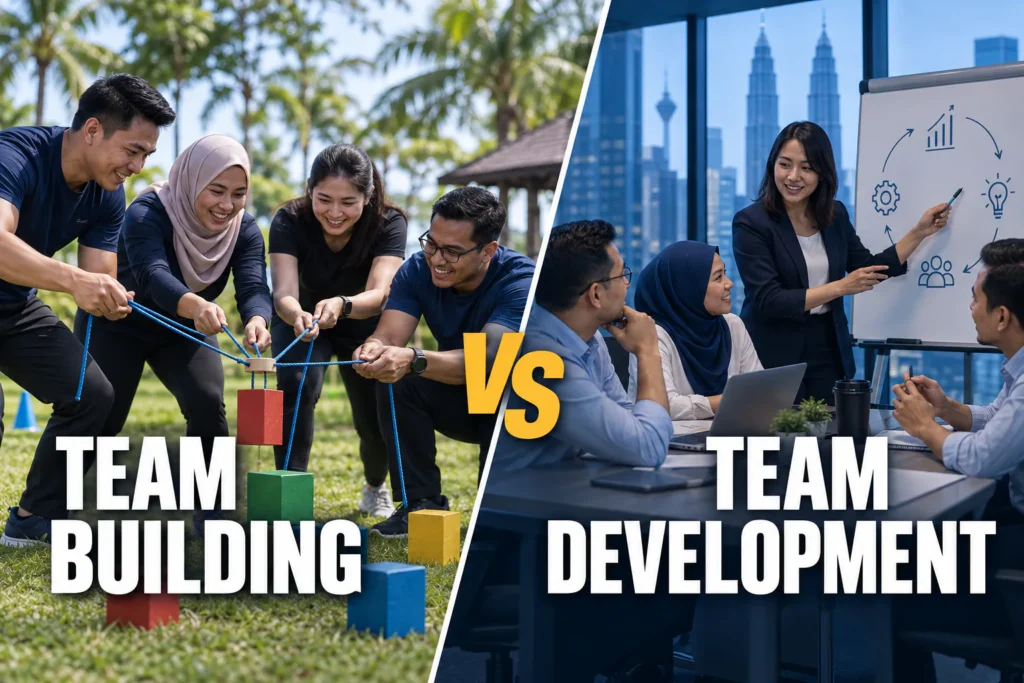
Team building is usually a defined event or intervention. Team development is a longer process of changing how a team communicates, makes decisions, handles conflict and follows through at work.
A corporate team-building programme may be enough when the organisation has one focused objective, such as reconnecting a newly formed team or improving cross-functional communication. A development journey is more suitable when the team needs repeated practice, manager reinforcement and progress reviews across several workplace habits.
Team building can also form part of team development. Choose according to how much depth, application and reinforcement the team’s situation requires.
For HR and L&D teams, the decision is how much depth the team needs now and what reinforcement the organisation can support afterwards.
Team Building and Team Development Have Different Time Horizons
Team building is usually a defined event or intervention, while team development is a longer process of changing team habits and performance.
A team-building programme concentrates attention on a selected team need. Participants may complete facilitated activities, discuss what happened and agree how they want to work together after the programme.
Team development carries that work into daily operations. The team applies new behaviours, reviews what is changing, receives reinforcement and returns to unresolved issues over time.
| Planning Question | Team Building | Team Development |
|---|---|---|
| What is the immediate need? | A focused intervention around connection, communication, alignment or collaboration | Sustained change across several team behaviours or performance conditions |
| Where does most learning happen? | During the facilitated programme and its reflection | During facilitated sessions and repeated workplace application |
| What happens afterwards? | The team applies its agreements with suitable internal follow-through | Application, reinforcement and review are built into the development process |
The time horizon does not decide quality. A focused programme is the right response to a focused need. A longer journey adds value when the problem is recurring, involves several connected behaviours or cannot be addressed through one intervention.
6 Elements of a Team-Building Programme
A team-building programme includes 6 elements: a clear objective, structured activities, facilitation, reflection, shared language and immediate team agreements.
The activity gives participants something concrete to work through together. Facilitation helps the group notice how it communicates, shares information, makes decisions, responds to pressure or handles different working styles.
Reflection then connects the experience to work. Without that connection, participants may remember the activity but leave without a clearer way to collaborate.
| Programme Element | Its Role |
|---|---|
| Clear objective | Defines the team behaviour or workplace issue the programme should address |
| Structured activity | Creates a shared situation where team behaviour becomes visible |
| Facilitation | Guides observation, discussion and learning without leaving the activity to speak for itself |
| Reflection | Connects the experience to meetings, handovers, decisions, conflict or other work situations |
| Shared language | Gives the team a practical way to discuss patterns and expectations |
| Team agreements | Turns discussion into specific commitments the group can use after the programme |
A programme may be delivered as a workshop, an offsite session or part of a retreat. The setting changes the planning conditions, but effective programme design still begins with the team objective.
For example, a team that struggles with handovers may need an activity that exposes missing information, followed by a discussion about ownership and a practical handover agreement. A generic activity chosen without that objective would be less useful.
A defined programme works best when the team can apply its agreements afterwards and someone inside the organisation can keep them visible.
5 Stages of Team Development
Team development follows 5 stages: diagnosis, facilitated learning, workplace application, reinforcement and review.
The process begins by defining the team’s current patterns and the behaviours that need to change. That diagnosis may come from stakeholder conversations, team input, observation, an assessment or a clear business problem already identified by the organisation.
Facilitated sessions give the team shared concepts and a place to practise. Workplace application shows whether those concepts survive real deadlines, meetings, handovers, decisions and disagreements.
- Diagnose: define the team problem, current patterns and desired behaviour.
- Learn and practise: use facilitated discussion, activities or simulations to build a shared approach.
- Apply: test the new behaviour in normal workplace situations.
- Reinforce: keep the agreed behaviour visible through manager support, team routines or follow-up prompts.
- Review: examine progress, address obstacles and decide what needs further work.
The cycle may repeat because team habits rarely operate in isolation. A communication problem may also involve unclear roles. Slow decisions may involve trust, authority or conflict. The development process gives the team time to work on those links without trying to solve everything in one session.
Effective team development has clear boundaries: defined behaviours, responsible people and review points. A longer programme without those elements is only a longer calendar.
5 Differences Between Team Building and Team Development
The 5 practical differences are duration, diagnosis, depth, outputs and reinforcement.
| Decision Factor | Team Building | Team Development |
|---|---|---|
| Duration | A defined event, workshop, offsite or retreat intervention | A sequence of learning, application, reinforcement and review |
| Diagnosis | Clarifies the immediate objective, participant group and relevant team situation | Examines recurring patterns, connected behaviours and the conditions affecting performance |
| Depth | Concentrates on a selected team need within a bounded programme | Works across behaviours that require repeated practice or several linked interventions |
| Outputs | Shared insights, language, immediate agreements and action points | A development focus, applied behaviour goals, review points and revised team practices |
| Reinforcement | May continue through client-led follow-through or a separate follow-up session | Forms part of the intervention through planned application and progress reviews |
A well-designed team-building programme gives the team a structured setting for useful agreements and serious discussion. Team development adds a more deliberate structure for testing whether the team uses those agreements at work.
Programme design and follow-through reveal more than the number of days. A retreat may still be one defined intervention, while a series of shorter sessions with workplace practice between them may form a development journey.
When a Team-Building Programme Is Enough
A team-building programme fits when the organisation needs focused alignment, connection, communication or collaboration work.
It is a sensible starting point when the objective is clear, the team is broadly functional and the problem does not require several rounds of practice or deeper organisational change.
A defined programme may be enough when:
- a newly formed team needs to learn how its members prefer to communicate and work together;
- a cross-functional group needs clearer handover or collaboration agreements;
- a team wants to reconnect and reset expectations after a demanding period;
- participants need a shared experience to begin a wider workplace discussion;
- the team has one specific objective that can be explored and converted into practical agreements; or
- the organisation has managers who can reinforce those agreements after the programme.
The programme should not promise to correct structural problems it cannot control. Unclear reporting lines, conflicting performance measures, unresolved workload issues or missing decision authority may require operational action as well as facilitated team work.
Choose the smallest intervention that can address the real need. Add more depth when the behaviour, business context or follow-through requires it.
When a Longer Team-Development Journey Is Needed
A longer journey fits when behaviour change requires repeated practice, manager reinforcement and measurement.
Recurring patterns are the clearest signal. If the team has discussed the same communication, trust or accountability problem before but old habits return under pressure, another standalone event may not provide enough application and review.
Consider a team-development journey when:
- several connected behaviours need to change;
- the team needs to practise new meeting, decision or conflict habits at work;
- a restructuring has changed roles, relationships or decision authority;
- leaders need to model and reinforce the same standards across departments;
- progress needs planned review points rather than an informal check-in; or
- an initial programme has surfaced issues that need further facilitated work.
An intact management team may need a more focused route. Leadership team building for management teams addresses shared priorities, decision-making, conflict, communication and collective accountability without turning the intervention into individual leadership training. Discuss a leadership team-building intervention with Image Revamp.
More sessions do not guarantee better development. Each stage needs a defined job, a clear link to workplace behaviour and an agreed way to review progress.
Plan the Right Level of Intervention
Choose a corporate team-building programme for a focused team need and a leadership team-building route when an intact management team needs deeper work on decisions, conflict, communication or accountability.
| Your Situation | Likely Starting Point |
|---|---|
| The team has one focused communication, connection, alignment or collaboration objective | A defined corporate team-building programme |
| The team needs repeated workplace practice and planned progress reviews | A longer team-development journey |
| An intact management team needs stronger shared decisions, conflict handling or accountability | A leadership team-building intervention |
| A focused programme has revealed deeper or recurring patterns | A sequenced development plan based on the issues identified |
| The objective, participant group or depth remains unclear | A scoping discussion before selecting activities or format |
Give the provider 6 facts before asking for a recommendation:
- Who will participate and whether they form an intact team.
- What is happening at work now.
- Which team behaviour or outcome needs to change.
- Whether the issue is focused or recurring.
- What managers can reinforce after the intervention.
- What timing, setting and operational constraints apply.
Image Revamp uses these 6 facts to scope a defined team-building programme or recommend a deeper development route. Confirm the programme details, deliverables and follow-up against the team’s objective during scoping.
Frequently Asked Questions
Team building and team development support the same broad goal at different levels of depth.
Is a one-day team-building event enough?
A one-day programme can be enough for a focused objective when the team can apply and reinforce its agreements afterwards. It is less likely to be enough when the problem is recurring, involves several behaviours or needs repeated workplace practice and review.
How long does team development take?
Team development does not have one fixed duration. Its length depends on the behaviours involved, the team’s starting point, the opportunities for workplace application and the number of review cycles needed.
Does team development include team-building activities?
Yes. Team development may use team-building activities, workshops or facilitated discussions. These interventions sit inside a longer cycle of diagnosis, application, reinforcement and review.
What happens after a team-building programme?
After a team-building programme, the team applies its agreements, reviews what changed and decides whether it needs further reinforcement. The exact follow-through depends on the programme objective and the organisation’s capacity to support the agreed behaviours.
Is team building part of team development?
It can be. A team-building programme may start a development journey, address one stage within it or serve as a focused intervention on its own. The role depends on the team problem and the follow-through required.