

SHARE:
Turn Assessment Results Into A Training Roadmap
Image Revamp helps HR teams interpret leadership assessment results, identify training priorities and build a practical development pathway for managers.
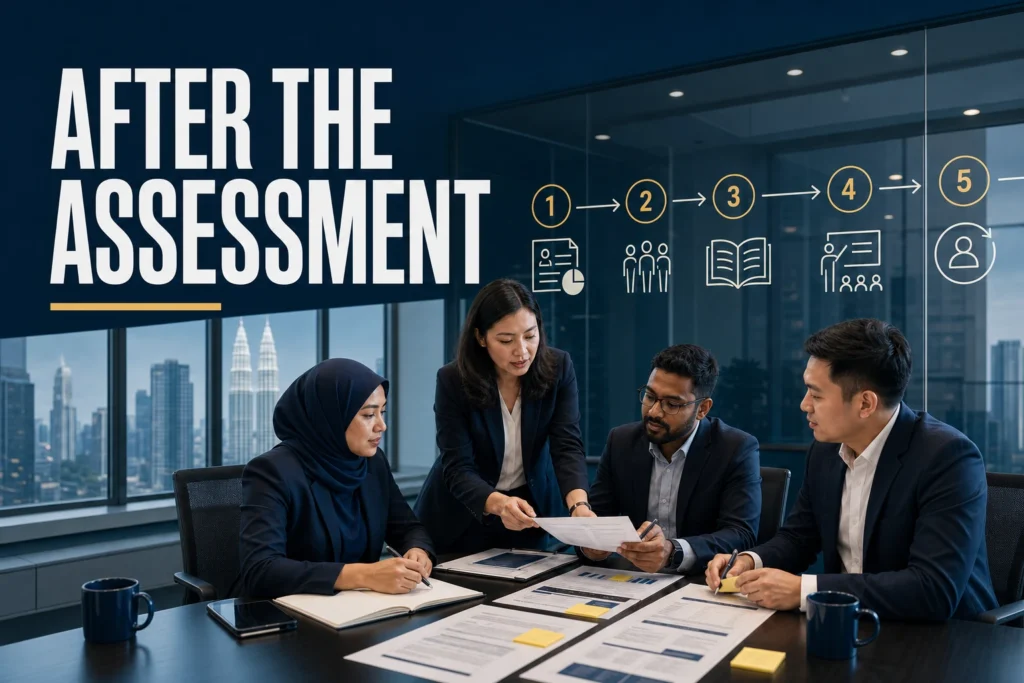
After a leadership assessment, HR should turn the results into development priorities, team conversations, manager actions and a training roadmap. The assessment report is useful only when managers understand what to do differently at work.
Image Revamp uses assessment results to build leadership playbooks, workshop recommendations and corporate training pathways for managers and teams. This helps the organisation move from insight to behaviour change.
In this article, you will learn how to:
- Identify the leadership patterns that matter most
- Translate assessment findings into observable workplace behaviours
- Build a leadership behaviour playbook managers can apply
- Choose a training pathway based on diagnostic evidence
- Review behaviour change after 30, 60 and 90 days
Explore assessment-led leadership development before turning your results into a post-assessment plan.
Why do leadership assessment results need an action plan?
Leadership assessment results need an action plan because insight without action rarely changes manager behaviour.
Many teams complete DISC, MBTI or CliftonStrengths profiles and enjoy the workshop moment, but the learning fades if nobody translates the findings into meetings, feedback, delegation, collaboration or coaching habits. HR needs a clear post-assessment process so the diagnostic becomes useful at work.
The report is evidence, not the final deliverable.
The practical output is a focused set of behaviours, team agreements, training priorities and follow-up actions that managers can use during real work.
If your organisation is still deciding which diagnostic fits, compare leadership assessment tools for corporate teams before building the action plan.
Step 1: Identify the main leadership patterns
The first step after a leadership assessment is to identify the patterns that matter most for the team.
Do not try to act on every detail in every report. Look for patterns connected to the original training goal. A DISC assessment may reveal communication pace differences, an MBTI-based workshop may reveal decision-making differences, and CliftonStrengths may reveal underused contribution patterns.
Useful post-assessment outputs include:
- Leadership gap summary
- Team style map
- Common communication risks
- Strengths and blind spots
- Training priorities
- Manager development themes
Step 2: Translate assessment findings into workplace behaviours
The second step after a leadership assessment is to translate findings into the specific behaviours managers need to practise.
Assessment labels are not the final output. HR and facilitators should convert the insights into workplace actions such as how managers give feedback, run meetings, delegate tasks, make decisions, handle conflict or coach team members.
| Assessment Finding | Behaviour Translation |
|---|---|
| Fast-paced communication style | Slow down and give context before assigning work. |
| High need for detail | Clarify decision criteria, evidence and deadlines. |
| Preference for reflection | Send pre-reading before discussion-heavy meetings. |
| Strong influencing theme | Use influence to align others without dominating airtime. |
| Low team trust | Add explicit team agreements and follow-up rituals. |
Step 3: Build a leadership behaviour playbook
The third step is to build a leadership behaviour playbook that managers can use after the workshop.
A playbook should be simple enough for managers to apply during real work. It can include team communication agreements, feedback principles, meeting norms, coaching prompts, conflict-handling habits and leadership commitments.
- Start: What should managers begin doing?
- Stop: Which habit or response is creating friction?
- Agree: Which team communication or decision rule should change?
- Reinforce: How will HR and department heads prompt the behaviour?
Step 4: Choose the right training pathway
The fourth step is to choose the training pathway that matches the assessment findings.
The assessment may show that the team needs communication skills training, team dynamics training, leadership presence, emotional intelligence, coaching skills, conflict management or a broader leadership development programme.
| Assessment Signal | Possible Training Pathway |
|---|---|
| Feedback conversations are weak | Communication skills training or coaching skills training |
| Conflict comes from style differences | DISC assessment and workshop for leadership teams |
| Managers lack self-awareness | MBTI assessment and workshop for leadership teams or emotional intelligence training |
| Strengths are underused | CliftonStrengths assessment Malaysia |
| Leadership presence is inconsistent | Leadership presence training |
| Team alignment is weak | Team dynamics training or a leadership offsite |
For a wider development need, use the findings to shape an assessment-led leadership training programme that sequences more than one capability.
Step 5: Measure behaviour change after the workshop
The final step is to measure whether assessment-led training changed useful behaviour.
Measurement does not need to be complicated. HR can track manager action plans, follow-up pulse checks, team feedback, coaching conversations and observed behaviour changes.
30 daysCheck application
Review manager commitments, early obstacles and whether the playbook is being used.
60 daysGather evidence
Use team feedback and pulse checks to identify visible behaviour shifts.
90 daysDecide what is next
Reinforce the priority, adjust the playbook or add the next training module.
FAQs
What should HR do after a leadership assessment?
HR should identify key patterns, translate the findings into workplace behaviours, choose training priorities and create follow-up actions for managers.
What should a leadership assessment report include?
A leadership assessment report should include the team’s main patterns, leadership gaps, communication risks, strengths, blind spots, training priorities and recommended manager actions.
How do you use DISC results after a workshop?
Use DISC results to improve communication, feedback, delegation, conflict management and team agreements. The goal is behaviour change, not labelling employees.
How do you use MBTI results for leadership development?
Use MBTI results to improve self-awareness, decision-making conversations, empathy for working-style differences and team dynamics.
How do you measure leadership assessment impact?
Measure leadership assessment impact through participant action plans, follow-up pulse checks, manager behaviour changes, team feedback and training-related enquiry or conversion signals.
How soon should training happen after a leadership assessment?
Training should happen within 30 to 60 days after a leadership assessment so the results are still fresh and managers can connect the findings to current team behaviours.