

SHARE:
Turn Assessment Results Into A Training Roadmap
Image Revamp helps HR teams interpret leadership assessment results, identify training priorities and build a practical development pathway for managers.
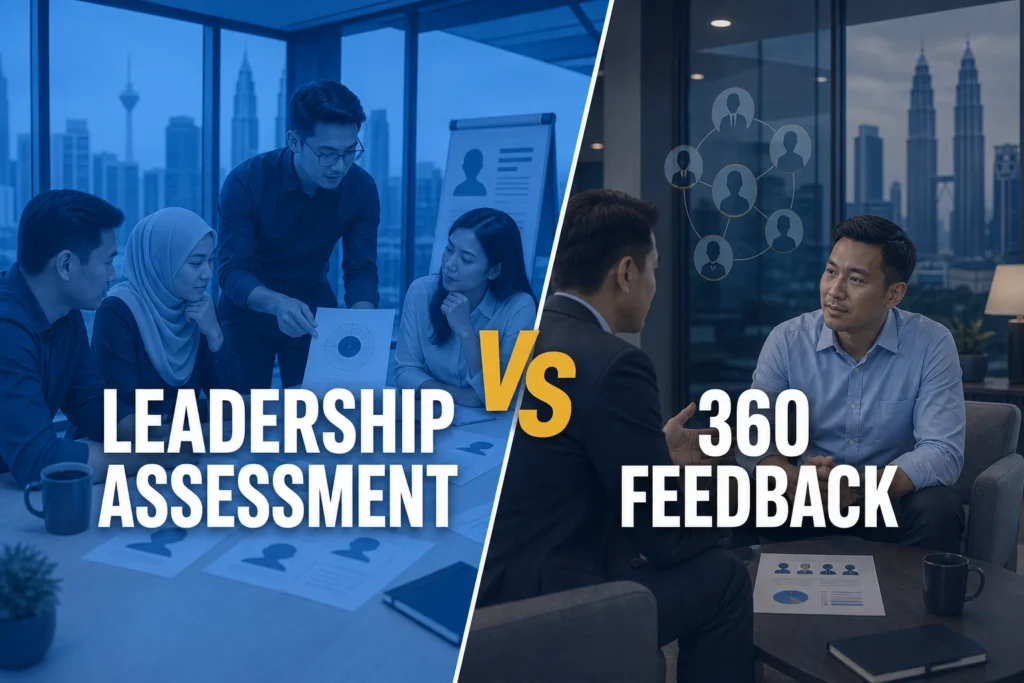
Leadership assessments and 360 feedback answer different leadership development questions. Leadership assessments such as DISC, MBTI and CliftonStrengths help managers understand style, preferences or strengths, while 360 feedback helps leaders understand how other people experience their behaviour.
Both can support leadership development, but they should not be treated as the same diagnostic. The right choice depends on whether HR needs self-awareness, communication language, strengths insight, stakeholder perception or evidence for coaching goals.
What is the difference between a leadership assessment and 360 feedback?
The difference is that a leadership assessment usually explains a leader’s style or profile, while 360 feedback gathers perceptions from people around the leader.
Leadership assessments often rely on self-reflection or profile-based questions. 360 feedback is usually multi-rater, meaning it collects feedback from stakeholders such as managers, peers, direct reports or internal customers.
| Diagnostic | What It Shows | Best Used For |
|---|---|---|
| DISC | Communication behaviour and behavioural style | Feedback, conflict, delegation and collaboration |
| MBTI-based workshop | Personality preferences and working styles | Self-awareness, decision-making and team dynamics |
| CliftonStrengths | Talent themes and natural contribution | Strengths-based leadership and role alignment |
| 360 feedback | How others experience leadership behaviour | Coaching goals, perception gaps and senior leadership development |
When should HR use a leadership assessment?
HR should use a leadership assessment when the team needs a shared language for development before or during training.
Profile-based assessments are useful when participants need to understand themselves and each other in a structured way. They can make workshops more relevant because the facilitator can connect learning to actual communication patterns, working preferences or strengths.
Use a leadership assessment when the goal is to:
- Improve manager communication.
- Build self-awareness and empathy.
- Understand team dynamics.
- Identify strengths and contribution patterns.
- Design an assessment-led leadership workshop.
- Create a practical leadership playbook after training.
HR teams comparing profile-based tools can use Image Revamp’s guide to the best leadership assessment tools for managers to choose between DISC, MBTI and CliftonStrengths.
When should HR use 360 feedback?
HR should use 360 feedback when leaders need structured input from people who work with them.
360 feedback can be powerful when a leader’s self-perception may differ from how others experience their behaviour. It is often useful for senior leaders, high-potential managers, coaching programmes and leadership development journeys where behaviour change needs to be specific and observable.
Use 360 feedback when the goal is to:
- Identify perception gaps.
- Gather feedback from multiple stakeholder groups.
- Support individual leadership coaching.
- Track behaviour change over time.
- Create evidence-based development goals.
Which diagnostic should come before leadership training?
The diagnostic that should come before leadership training depends on what the training needs to change.
If the training is about communication, collaboration or team dynamics, DISC, MBTI or CliftonStrengths may be enough. If the training is for senior leaders who need behaviour feedback from others, 360 feedback may add useful evidence.
| Training Goal | Recommended Diagnostic |
|---|---|
| Improve communication habits | DISC |
| Build personality-preference awareness | MBTI-based workshop |
| Strengthen strengths-based leadership | CliftonStrengths |
| Identify perception gaps | 360 feedback |
| Build a full training roadmap | Training needs diagnostic plus selected assessment |
The selected diagnostic should support the intended leadership training programme, not become a standalone report with no development action.
Can leadership assessments and 360 feedback work together?
Leadership assessments and 360 feedback can work together when the organisation needs both self-awareness and stakeholder perception.
For example, DISC might help managers understand how they naturally communicate, while 360 feedback might reveal whether their team experiences that communication as clear, supportive, rushed or inconsistent. Together, these inputs can make leadership coaching and training more specific.
The organisation still needs to turn the findings into clear workshop actions and manager development priorities. Use the five-step guide on what to do after a leadership assessment to build that next-stage plan.
FAQs
Is 360 feedback a leadership assessment?
360 feedback can be considered a type of leadership diagnostic, but it is different from profile-based assessments because it gathers feedback from other people instead of only describing a style, preference or strength pattern.
Is 360 feedback better than DISC or MBTI?
360 feedback is not automatically better than DISC or MBTI. It is better when the organisation needs stakeholder perception. DISC and MBTI are better when the organisation needs style, behaviour or preference language for training.
Should managers complete a leadership assessment before 360 feedback?
Managers can complete a leadership assessment before 360 feedback if the programme needs self-awareness first. For senior leaders, 360 feedback may come first if the main goal is to understand stakeholder perception.
Can 360 feedback be used in leadership training?
Yes. 360 feedback can be used in leadership training when the feedback is handled carefully, confidentially and connected to development goals rather than punishment.