

SHARE:
Choose the Right Development Route
Tell us whether the priority is manager capability, team effectiveness or both, and we can route the enquiry to the right programme.
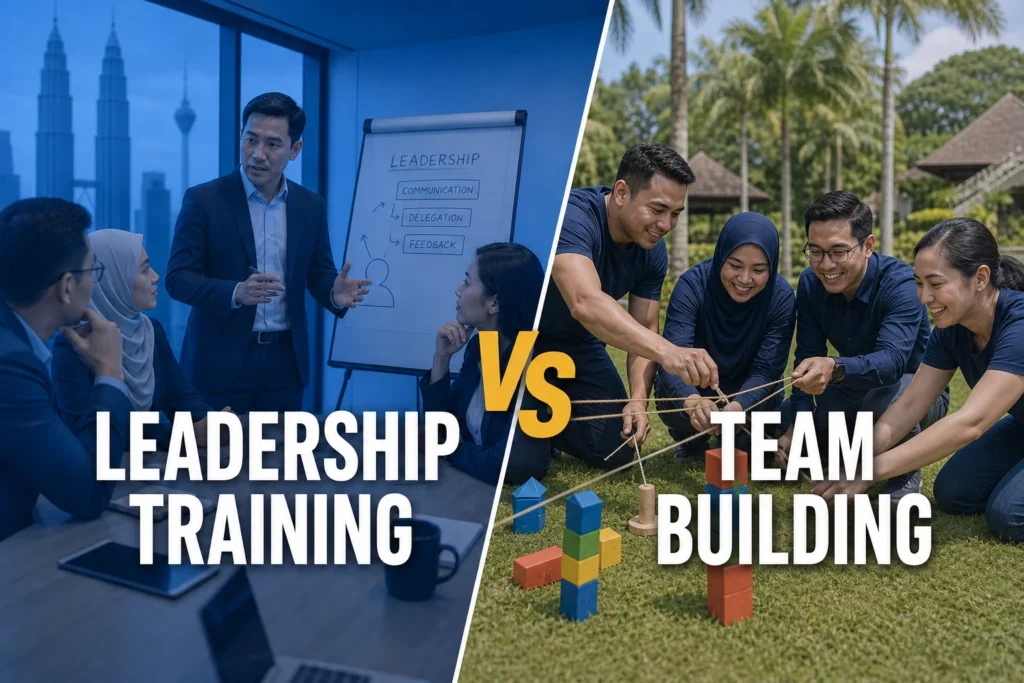
Leadership training develops individual manager capability. Team building improves collective team effectiveness.
Start with the unit that needs to change. If managers need to communicate expectations, delegate work, give feedback or make decisions, leadership training is the more direct route. If a group needs stronger trust, alignment, collaboration or shared working habits, team building is the better starting point.
Malaysian HR and L&D teams may also need both. An organisation can develop individual managers while helping the wider management team operate with clearer priorities, decisions and accountability.
Leadership Training and Team Building Solve Different Problems
Leadership training develops individual leadership capability, while team building improves how a group works together.
Leadership training targets a manager’s behaviour in a leadership role. Team building targets the group’s interactions and shared habits.
| Main Problem | More Relevant Starting Point |
|---|---|
| Managers give unclear instructions | Leadership training |
| Managers avoid feedback or coaching | Leadership training |
| One or more managers struggle to delegate | Leadership training |
| Departments work in silos | Team building |
| Team members do not trust one another | Team building |
| Meetings end without shared priorities or ownership | Team building |
| Managers need stronger skills and the management team lacks alignment | Both |
Managers may attend either intervention. The intended outcome decides the route: individual capability or collective effectiveness.
A team-building activity does not correct every manager’s delegation or feedback problem. Leadership training does not automatically create trust or shared operating habits across an intact team.
What Leadership Training Develops
Leadership training develops the communication, delegation, feedback, coaching, decision-making and accountability behaviours that managers use in daily work.
| Capability | What the Manager Needs to Do |
|---|---|
| Communication | Explain priorities, expectations and decisions clearly |
| Delegation | Assign ownership with suitable authority and support |
| Feedback | Address performance and behaviour specifically and promptly |
| Coaching | Ask useful questions and support people’s development |
| Decision-making | Make decisions, explain the reasoning and communicate the next action |
| Accountability | Set commitments, review progress and address missed ownership |
These skills affect ordinary workplace situations: a manager briefing a team, assigning a project, correcting a performance issue, coaching a direct report or deciding between competing priorities.
Choose leadership training when the organisation has a manager-capability gap. Common signs include inconsistent leadership standards, managers becoming bottlenecks, unclear expectations, delayed decisions and difficult performance conversations.
Where HR or L&D teams need more evidence before choosing a development route, leadership assessments for corporate teams can clarify the development question. An assessment supports the training decision; it does not replace practice, feedback or workplace application.
DISC can help explain observable communication behaviour, feedback and conflict patterns. MBTI can support discussion about preferences, decision-making and working styles. Use either tool only when it answers the development question.
What Corporate Team Building Improves
Corporate team building improves shared communication, trust, collaboration, alignment and the team-working habits that shape collective performance.
Team building addresses problems that involve several people at once. The group may need to communicate across roles, make shared decisions, rebuild trust or agree how it will work together.
| Team Effectiveness Area | What the Group May Need to Improve |
|---|---|
| Shared communication | Use clearer language, listening practices and handover expectations |
| Trust | Increase reliability, openness and willingness to raise concerns |
| Collaboration | Work across roles or departments with less friction |
| Alignment | Agree priorities, roles, responsibilities and common outcomes |
| Team-working habits | Improve meetings, decisions, conflict handling and follow-through |
Use team building when several people contribute to the same problem. Examples include a newly formed team without working agreements, a cross-functional group with weak handovers or a department experiencing low trust after restructuring.
A team-building programme should start with the team challenge rather than a list of activities. A useful objective might be to improve cross-functional handovers, establish clearer decision ownership or create better communication habits between departments.
Activities become more useful when structured reflection connects them to workplace behaviour. The exact activities and deliverables depend on the confirmed objectives and programme design.
When participants form an intact management team and the problem involves leadership alignment, decision-making, conflict or collective accountability, consider a leadership team-building programme. That route is different from individual manager training and broader company bonding.
Leadership Training vs Team Building: 6 Decision Factors
The clearest choice comes from comparing objective, participants, problem, duration, deliverables and follow-through.
| Decision Factor | Leadership Training | Team Building |
|---|---|---|
| Objective | Develop individual manager capability and leadership behaviour | Improve collective communication, trust, collaboration, alignment and team habits |
| Participants | Managers, supervisors, emerging leaders or a defined leadership population | An intact team, department, cross-functional group or management team |
| Problem | Inconsistent communication, delegation, feedback, coaching, decisions or accountability | Siloes, weak trust, unclear alignment, poor collaboration or unhelpful group habits |
| Duration | Set by the capability scope, practice time and reinforcement required | Set by the team objective, group context, setting and shared practice required |
| Deliverables | Individual action priorities, practice goals, feedback points or assessment insights where relevant | Shared language, team agreements, collaboration commitments or agreed working habits |
| Follow-through | Manager practice, supervisor observation, coaching or individual action review | Team review of agreements, working habits, ownership and collective commitments |
Duration comes after the objective. A longer programme is not automatically better, and a shorter intervention is not automatically insufficient. The scope should match the behaviours or team habits that need to change.
The same activity can serve different purposes. A problem-solving exercise may help a manager practise delegation. The same exercise may help a team examine collaboration and shared decision-making. The purpose and discussion determine the intervention’s role.
Ask one question before selecting a provider or format: is the organisation trying to improve what particular managers do, how a group works together, or both?
When an Organisation Needs Both
Use both routes when individual manager capability and collective team effectiveness limit performance at the same time.
Examples include:
- Newly promoted managers need stronger communication, delegation and feedback skills, while the management team needs shared operating agreements.
- A restructuring has changed reporting lines, roles and cross-functional relationships.
- Managers have completed training, but the wider team still experiences siloed decisions or unclear ownership.
- An organisation wants to improve individual leadership behaviour while aligning an intact executive or management team.
- A team-building programme identifies individual capability gaps that require separate leadership development.
A practical planning sequence has four steps:
- Identify the current workplace problem.
- Separate individual manager behaviours from collective team behaviours.
- Define participants and intended outcomes for each intervention.
- Agree how the organisation will review application after the programme.
The two routes may be delivered together or in sequence. Leadership training can develop individual skills, while team building helps the management team apply shared communication, decision-making and accountability habits.
Do not expect one group event to resolve every individual skill gap. Do not expect manager training alone to repair poor trust, unclear team agreements or weak cross-functional collaboration.
Choose the Right Next Step
Choose leadership training for manager capability, Leadership Team Building for an intact management team, and corporate team building for broader team effectiveness.
| Your Situation | Likely Next Step |
|---|---|
| One manager or a group of managers needs stronger leadership behaviours | Leadership training |
| An intact management team needs alignment, communication, decision-making or accountability | Leadership Team Building |
| A department or broader group needs trust, collaboration, communication or shared working habits | Corporate team building |
| The organisation has individual and collective needs | A combined or sequenced intervention |
| The problem, participant group or format remains unclear | Request a customised team-building proposal |
Give the provider five facts:
- Who will participate.
- Which managers, departments or teams are involved.
- What is currently not working.
- What should change after the intervention.
- What date, setting and operational constraints apply.
Also state whether the priority is individual capability, collective team effectiveness or both.
HRD Corp requirements affect documentation and planning, but they do not decide the intervention. Identify the workplace need first, then confirm the relevant administrative requirements separately.
Frequently Asked Questions
Leadership training and team building answer different organisational needs.
Is team building the same as leadership training?
No. Leadership training develops individual manager capability, while team building improves how a group communicates, collaborates, trusts and works together.
Should managers attend team-building programmes?
Yes, when the objective concerns the effectiveness of the whole group. If the main issue is an individual manager’s delegation, feedback, coaching or decision-making, leadership training is more precise.
Can leadership training include team-building activities?
Yes. Leadership training may use group exercises, simulations or discussion activities, but the intended outcome remains individual leadership capability.
Which option is better for a newly formed management team?
A newly formed management team may need both. Leadership training builds individual manager capability, while leadership team building establishes shared priorities, communication standards, decision-making habits and accountability.
Is a leadership assessment necessary before choosing an intervention?
No. An assessment is useful when HR needs more evidence about manager behaviour, preferences, strengths or development needs. It is not required when the organisational problem and desired intervention are already clear.